
What is Rejection Sensitivity Dysphoria (RSD)?
You may or may not have heard of Rejection Sensitivity Dysphoria (RSD); if you haven't, then you are about to have your eyes very widely opened. If you have, then you may want to delve a little deeper into understanding what's going on in our brains, the ways it can show up and how we can reduce the impact on us throughout our daily lives.
In this blog, I'll explain what RSD is, why it's so common in neurodivergent people including those who are ADHD, AuDHD, Autisitic, Highly Sensitive People (HSP), how it can affect your daily life and what you can do to better understand and manage it.

What is Rejection Sensitivity Dysphoria (RSD)?
Rejection Sensitivity Dysphoria (RSD) is a term used to describe the intense emotional reaction, sometimes physical pain, that some people experience after real or perceived rejection, criticism or 'failure'.
The term Rejection Sensitivity Dysphoria was popularised by ADHD specialist Dr William Dodson; it is not currently a formal diagnosis in the DSM-5*. Research has consistently shown that RSD and emotional dysregulation is a common feature of ADHD but many autistic, AuDHD, HSP people and those with other neurodivergent conditions also describe similar experiences.
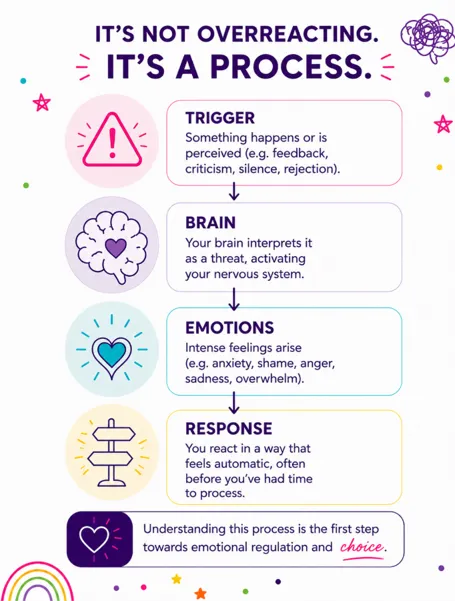
It isn't about being 'too sensitive' or choosing to overreact. It's about how the brain processes emotions, detects threats and responds to situations that feel unsafe.
Whether you call it RSD or emotional sensitivity, the experience is very real. For many neurodivergent people, emotions feel bigger, arrive faster and take longer to settle.
Why Does RSD Happen and How?
Many neurodivergent people, including those with ADHD, autism, AuDHD and those who are Highly Sensitive People (HSP), experience heightened sensitivities. We often think about sensory sensitivities such as noise, bright lights, certain textures or busy environments, but emotional sensitivity is simply another part of our sensory profile.
This means that criticism, rejection or feeling as though you've let someone down isn't just processed as information. Your brain can experience it as something much bigger, triggering an emotional and physical response that feels difficult to control.
So, why is this happening - hopefully you know me by now but I love the science part....
Emotional regulation is one of our executive functions, the mental skills that help us pause, think clearly, manage our emotions and respond appropriately to situations. In ADHD, research suggests these executive functions develop more slowly, with around a 30% developmental delay, making it harder to regulate emotions in the moment. Difficulties with emotional regulation are also recognised in many autistic people and can be influenced by differences in sensory processing and the way the brain responds to stress.
At the same time, several brain networks are working behind the scenes. The Salience Network decides what deserves your attention and can place enormous importance on criticism or perceived rejection. The Default Mode Network (DMN), responsible for reflection and self-talk, can then become stuck replaying the situation over and over, searching for answers or trying to prevent the same thing happening again. When your emotions are already running high, it becomes much harder to access the executive functioning needed to put the situation into perspective.
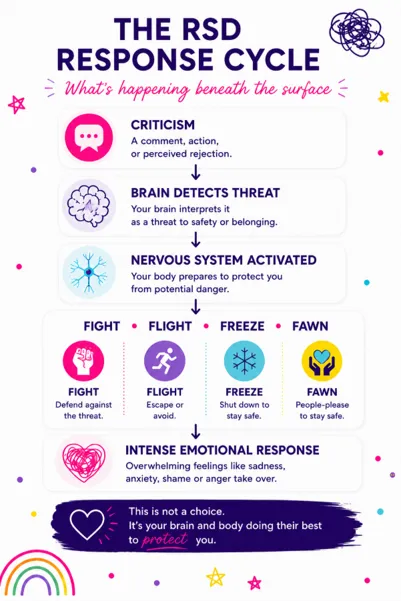
This is why RSD can feel so overwhelming. It's not simply one emotional reaction! It's the result of heightened sensitivities, differences in emotional regulation, the brain's threat detection system and a nervous system that has shifted into survival mode.
This process can happen in a matter of seconds and often before we're even consciously aware of it. The diagram below shows what is happening beneath the surface when RSD is triggered.
The Hidden Cycle of RSD
RSD isn't just about the moment you feel rejected. It's about what happens afterwards and, for many people, what happens over years or even decades.
When rejection feels intensely painful, your brain naturally tries to stop it from happening again. It begins looking for ways to keep you safe. At first, these coping strategies can seem helpful, but over time they can quietly shape the way you think, behave and interact with the world.
🌈 You might become a people pleaser because keeping everyone happy feels safer than risking conflict.
🌈 You might become a perfectionist because if everything is perfect, nobody can criticise you.
🌈 You may struggle to say no, avoid difficult conversations, constantly seek reassurance or question your own abilities, leading to imposter syndrome.
🌈 Many neurodivergent people also begin masking, hiding parts of themselves or changing their behaviour to avoid being judged or rejected.
These aren't personality flaws. They're protective strategies that your brain has developed over time.
In neurodivergent brains (including ADHD and Autism), this communication can work differently:
Signals between brain networks may be less efficient or more variable
Dopamine regulation (linked to motivation, reward, and focus) can function differently
Regulation and organisation systems may develop on a different timeline
Research and clinical observations suggest that there can be around a 30% delay in executive functioning compared to neurotypical (not neurodivergent) development.
This does not mean anything is missing or broken, it simply reflects differences in timing, regulation, and brain connectivity.
The difficulty is that these strategies come at a cost. Constantly monitoring yourself, trying to avoid mistakes, keeping everyone else happy and staying on high alert requires an enormous amount of emotional energy. Over time, your nervous system rarely gets the opportunity to fully switch off.
For many neurodivergent people, this can become a cycle and matches closely the Burnout Cycle (Blog coming soon!).
Heightened sensitivities → Rejection (perceived or real) feels more intense → Emotional dysregulation and emotional flooding → Rumination and overthinking → People pleasing, perfectionism, masking and avoidance → Nervous system overload → Burnout
When RSD Leads to Burnout
RSD isn't always about one difficult moment. Sometimes it's the constant cycle of self-doubt, overthinking and emotional stress that gradually wears us down.
I experienced this myself while working with a client who constantly made me question my abilities. Every interaction left me feeling anxious (I literally felt sick to my stomach), ashamed and convinced I wasn't good enough. I began doubting my experience, replaying conversations and questioning every decision I made. Eventually, I made the difficult decision to end the working relationship.
What surprised me was that the emotional impact didn't stop there.
For months afterwards, my brain continued replaying everything that had happened. I withdrew from people, lost confidence in myself and struggled to move forward. Looking back, I can now see that it wasn't just RSD. It had contributed to burnout.
When our nervous system spends long periods in survival mode, it becomes much harder to recover. That's why understanding RSD isn't just about managing emotions. It can also play an important role in protecting our mental health and preventing burnout.
Emotional Regulation and Your Nervous System
Learning to manage RSD isn't about becoming tougher or ignoring your feelings. It's about recognising when your nervous system has been activated and giving your brain the support it needs.
When we're emotionally regulated, we're much better at being able to think clearly, communicate calmly and put situations into perspective. When we're dysregulated, everything can feel bigger, more urgent and more personal.
So, you can't stop RSD - Sorry! But we can reduce the intensity, shorten the recovery time and respond with more choice than reaction.
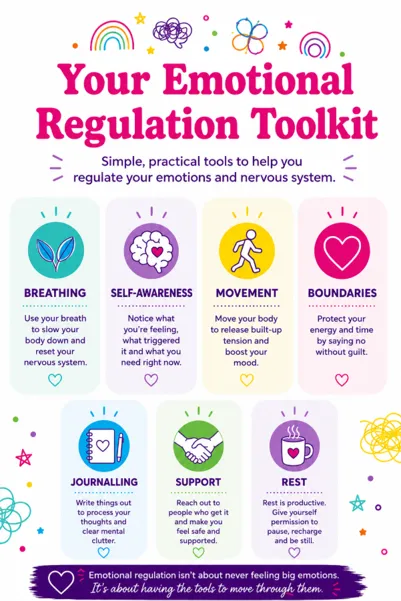
❤️ Learn your triggers
Notice the situations, people or environments that leave you feeling criticised, rejected or emotionally overwhelmed. The earlier you spot a trigger, the easier it becomes to support yourself before emotions take over.
🌈 Pause before believing the story
RSD often makes assumptions feel like facts. While I am not a therapisrt, I often fine myself saying to my clients 'Do we know this to be true?'
🧠 Regulate your nervous system first
Slow breathing, movement, taking a sensory break, spending time outside or simply stepping away from the situation for a few minutes can all help your brain feel safer.
💜 Interrupt the rumination cycle
Your brain is trying to protect you by replaying what happened, but endless overthinking rarely provides an answer. Journalling, talking things through with someone you trust or gently redirecting your attention can help break the loop.
⭐ Challenge perfectionism and people pleasing
Ask yourself whether you're doing something because it's genuinely important to you or because you're trying to avoid criticism or rejection. Not every situation requires perfection, and you don't have to keep everyone happy to be accepted.
🤍 Protect your energy with healthy boundaries
Boundaries aren't selfish; they're a way of protecting your wellbeing. Spending less time with people who repeatedly leave you feeling anxious, criticised or emotionally drained can make a huge difference.
🌿 Practise self-compassion
RSD isn't a weakness or a personality flaw. Your brain has developed protective strategies to help keep you safe. Understanding those patterns with curiosity, rather than criticism, is often where real change begins.
What Does Being Emotionally Regulated Look Like?
Rejection Sensitivity Dysphoria can affect every area of life, from relationships and friendships to work, parenting and everyday interactions. Understanding what's happening in your brain doesn't make the emotions disappear overnight, but it can help you respond with greater awareness and compassion instead of self-criticism.
The goal isn't to stop feeling emotions. The goal is to recognise what's happening, regulate your nervous system and reduce the amount of time those emotions have control over your life.
When I learnt about RSD, this was the moment everything started to make sense. I didn't just understand why criticism affected me so deeply. I finally understood why I'd spent years people pleasing, striving for perfection, doubting myself and ending up burnt out. Recognising that these patterns were protective responses, rather than personal failings, completely changed how I viewed myself.
With understanding, self-awareness and the right support, it is possible to build confidence, recover more quickly and work with your neurodivergent brain rather than constantly feeling like you're fighting against it.
If you recognised yourself in this blog, please know you're not alone. Understanding what's happening in your brain is often the first step towards making meaningful, lasting changes. You don't have to keep pushing through until you reach burnout again.
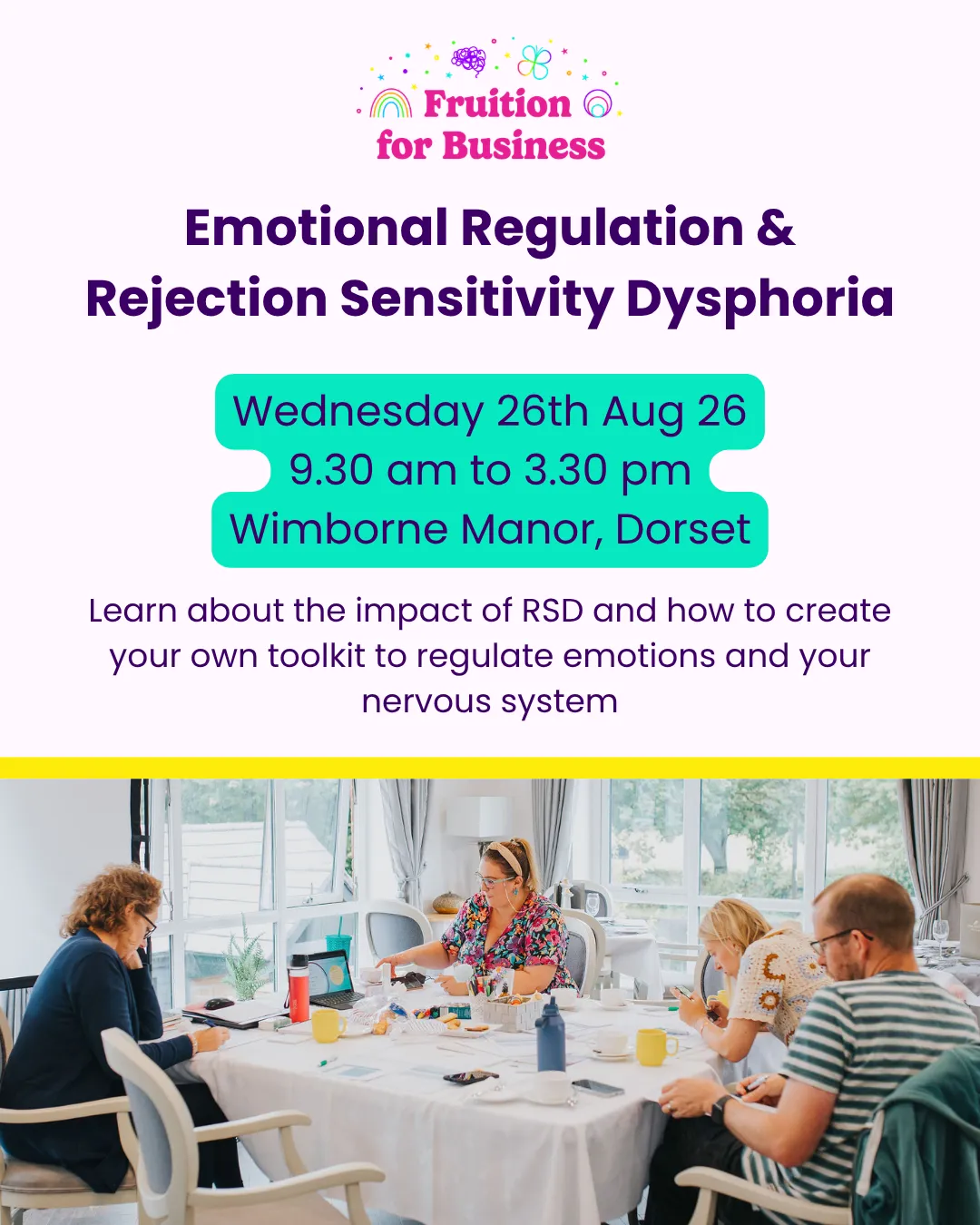
Join me for: Emotional Regulation & RSD
📅 Wednesday 26th August 2026
🕤 9.30am - 3.30pm
📍 Wimborne Manor, Dorset
☕ Includes refreshments, snacks, lunch, workbook and a little gift
Knowing what you need to do, but struggling to initiate it
Feeling overwhelmed by simple or multi-step tasks
Losing track of time or switching tasks becomes difficult
Emotional reactions feel stronger or harder to regulate than expected
Not sure what's right for you?
If you'd like to talk through your situation first, book a free Connection Call and we can explore the best next step together.
*The DSM-5 (Diagnostic and Statistical Manual of Mental Disorders, Fifth Edition) is the handbook used by healthcare professionals to diagnose and classify mental health conditions. It is currently also used to diagnose neurological conditions like ADHD and Autism.