
Understanding Your Neurodivergent Brain: Executive Functions
Have you ever wondered why something small, like catching your cardigan on a door handle, can suddenly feel way bigger than it should? Why you can hyperfocus for hours on one thing, but struggle to start something else? Why switching between tasks feels overwhelming, time seems to disappear or not exist at all, and why planning something is one thing… but actually doing it is another?
This is where executive functions come in.
Understanding them can genuinely change how you experience life, especially as a neurodivergent person. It gives context to things that may have felt confusing, frustrating, or even personal. This blog is going to break down Executive Dysfunction and some ways we can help our own executive functioning.
If reading a blog is not your thing, then this is exactly what I go deeper into in my Executive Functions Explained workshop, where we break this down in a way that feels relatable, practical and grounded in real life.
What are Executive Functions?
Executive functions are often described as the operating system of your brain. Imagine your brain like a computer; executive functions are the background system that keeps everything running, organising files, managing tasks, allocating attention, and helping you switch between programs smoothly.
When this system is working well, life feels more manageable. You can plan, start tasks, switch focus, and regulate emotions with more ease.
When it’s not working efficiently, everything can feel slower, heavier, or harder to coordinate, even when you know what needs to be done.
Executive functions are primarily managed by the prefrontal cortex, the front part of the brain that contributes towards our behaviours, managing emotions and cognitive processing. This may look like decision-making, planning, prioritising, emotional regulation, etc.
This system doesn’t work alone. It relies on communication between different brain networks, including those involved in emotion, memory, and reward.

In neurodivergent brains (including ADHD and Autism), this communication can work differently:
Signals between brain networks may be less efficient or more variable
Dopamine regulation (linked to motivation, reward, and focus) can function differently
Regulation and organisation systems may develop on a different timeline
Research and clinical observations suggest that there can be around a 30% delay in executive functioning compared to neurotypical (not neurodivergent) development.
This does not mean anything is missing or broken, it simply reflects differences in timing, regulation, and brain connectivity.
Executive functions are often described as the operating system of your brain. Imagine your brain like a computer; executive functions are the background system that keeps everything running, organising files, managing tasks, allocating attention, and helping you switch between programs smoothly.
When this system is working well, life feels more manageable. You can plan, start tasks, switch focus, and regulate emotions with more ease.
When it’s not working efficiently, everything can feel slower, heavier, or harder to coordinate, even when you know what needs to be done.
Executive functions are primarily managed by the prefrontal cortex, the front part of the brain that contributes towards our behaviours, managing emotions and cognitive processing. This may look like decision-making, planning, prioritising, emotional regulation, etc.
This system doesn’t work alone. It relies on communication between different brain networks, including those involved in emotion, memory, and reward.
In neurodivergent brains (including ADHD and Autism), this communication can work differently:
Signals between brain networks may be less efficient or more variable
Dopamine regulation (linked to motivation, reward, and focus) can function differently
Regulation and organisation systems may develop on a different timeline
Research and clinical observations suggest that there can be around a 30% delay in executive functioning compared to neurotypical (not neurodivergent) development.
This does not mean anything is missing or broken, it simply reflects differences in timing, regulation, and brain connectivity.
What is Executive Dysfunction and Why it happens?
Executive dysfunction occurs when our brain’s ‘operating system’ feels overloaded; this, along with the 30% delay, can lead to struggles with things like tasks, emotions, information processing, and decision-making.
For neurodivergent people, this often comes down to differences in how the brain handles attention, regulation, motivation, and overwhelm. Stress, sensory overload, burnout, lack of sleep, or simply having too much going on can all make executive functioning even harder to access.
It can look like:
Knowing what you need to do, but struggling to initiate it
Feeling overwhelmed by simple or multi-step tasks
Losing track of time or switching tasks becomes difficult
Emotional reactions feel stronger or harder to regulate than expected
Knowing what you need to do, but struggling to initiate it
Feeling overwhelmed by simple or multi-step tasks
Losing track of time or switching tasks becomes difficult
Emotional reactions feel stronger or harder to regulate than expected

A lot of neurodivergent people also develop coping strategies or masking behaviours without even realising it. You might look organised, capable, or like you’ve got it all together on the outside, while internally it takes a huge amount of effort just to stay on top of things.
Eventually, that constant pressure can catch up with you and lead to burnout, where even basic tasks or decisions can start to feel impossible.
Executive dysfunction isn’t laziness or failure!! Your brain isn’t broken!! It’s simply a different way of processing and managing information, energy, and regulation and understanding that can help you start working with your brain instead of constantly fighting against it.
The 8 Key Executive Functions
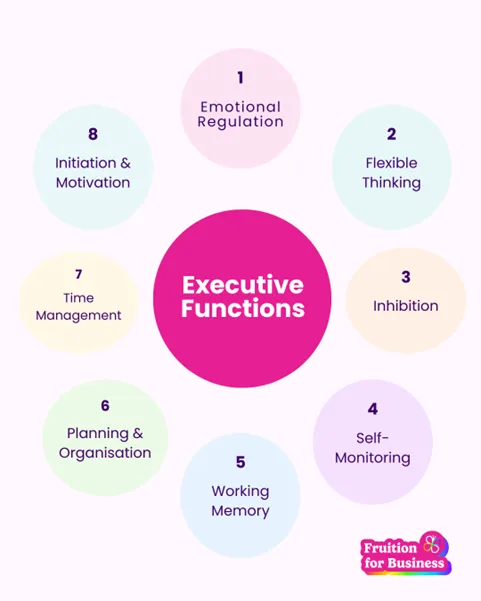
These are the core areas often impacted in neurodivergent individuals:
Emotional Regulation – managing emotional responses (this can link to rejection sensitivity)
Flexible Thinking – adapting to change or seeing different perspectives
Inhibition (Impulse Control) – pausing before acting or speaking
Self-Monitoring (Self-Awareness) – noticing your behaviour and its impact
Working Memory – holding and using information in the moment
Planning & Organisation – structuring tasks and steps
Time Management – understanding and using time effectively
Task Initiation & Motivation – getting started on things
These don’t work in isolation. They constantly overlap and influence each other.
For example:
If working memory is overloaded, planning becomes harder
If emotions are heightened, starting tasks can feel impossible
If time feels abstract, organisation can fall apart
It’s not multiple failures; it’s one system under pressure.
Executive Function Strategies: How to Manage Executive Dysfunction
Here are some of my favourite strategies that I either use or recommend to clients to try. These strategies can help you navigate the challenges of executive dysfunction in various aspects of your life.
Before you dive in, just remember, you don’t need to try all of these - this isn’t about finding the ‘perfect’ system. It’s about understanding your brain well enough to find what fits. Be open to trying different things and have fun exploring what works for you. Be aware that it may work for a while, and then you may need to change it up.

Planning Strategies for Executive Function
Use Visual Aids: Create visual planners or simple to-do lists. Visual cues help you see your tasks clearly and stay organised. The saying goes: Out of sight, out of mind!
Set Aligned Goals: You may be driven by dopamine, so make sure you work towards goals you want to do and achieve. This will help with motivation too.
Small, Small, Small: Break down your goals or tasks into small, achievable steps. This makes planning and execution more manageable. Use an AI Tool or Goblin.tools to help with breaking down tasks.
Time Management Strategies
Learn your time management style: I have learned I am an all or nothing person. I don’t like switching between tasks. I’d rather have all client calls on one day and all my admin/business stuff on another. You may love time blocking your diary and can make it fun with colours and splitting your day into sections.
Set Reminders: Use alarms or digital reminders to prompt task transitions or deadlines. I personally love my visual timer – take a look here. I also have a Smart watch which pings at me and my new best friend, Alexa!
Impulse Control and Focus Strategies
Create a Distraction-Free Zone: Designate a workspace where distractions are minimised. You could use apps to block websites and social media but the best thing I did was just start by putting my phone on ‘do not disturb’.
Take mindful breaths: Pausing and taking a few deep breaths when tempted by distractions or wanting to reply impulsively!!
Working Memory Strategies
Use Note-Taking Tools: Carry a notebook or use note-taking apps to jot down important information or ideas and have them EVERYWHERE!!!
Make Everything Visual: Use wall calendars, post-it notes, your phone's wallpaper, there are so many options. However, for me, I add everything to do a to-do app and also my diary. If I don’t put it in either of those, poof, gone forever!
Small, Small, Small (Again!): Break down complex information into smaller chunks. This aids memory retention.
Emotional Regulation Strategies

Practice Self-Care: Regularly engage in activities that help you manage stress, such as meditation, exercise or hobbies you enjoy.
Identify Triggers: Recognise situations or triggers that may lead to emotional dysregulation. Perhaps make a note of them somewhere so then you can start developing strategies to handle them proactively.
Seek Support: Don't hesitate to talk to a therapist, counsellor or coach if you find emotional control challenging. They can provide valuable coping strategies.
Task Initiation Strategies
Accountability Buddy: Get someone else to hold you accountable whether a friend or a professional coach. Body Doubling is also amazing for helping you just begin when something feels incredibly hard.
Make It Fun: Sometimes you need to start with doing the fun thing first, this can help you get going. Your environment also has a huge impact, so do you love where you are and what’s surrounding you. If you are happy, you are more likely to get started and be engaged.
Flexibility and Adaptability Strategies
Mindfulness and Breathing: When faced with unexpected changes or stress, take a moment to breathe deeply and regain composure before reacting.
What’s in my control?: After taking a moment to pause, it can also be helpful to review what’s within our control. Some things are but a lot most likely isn’t. To help reduce the anxiety of change it can be helpful to regain understanding of what we can control. This does take practice though.
Understanding Your Neurodivergent Brain
Let’s face it, executive dysfunction can kick our butt, BUT I want you to find a new sense of empowerment. The biggest strategy of all is compassion for yourself.
A lot of this comes down to brain wiring; it’s not something you can simply switch off or fully control. For example, you can absolutely practise ‘flexible thinking’, but the reality is that transitions and changes will still feel harder for a neurodivergent brain. You can practice and learn time management techniques, but time blindness is a real thing for neurodivergent people.
That’s why I believe in Knowledge plus Understanding equals Acceptance. You can learn about executive functions, but when you start to understand your brain and how it truly works and then accept different ways of thinking and working for YOU, then life can be wonderful!
If this blog has resonated with you and you want to understand your executive functions on a deeper level, I’m running a live, in-person workshop: Executive Functions Explained on the 20th May. This is part of a 3-part series all around Understanding your Neurodivergent Brain.
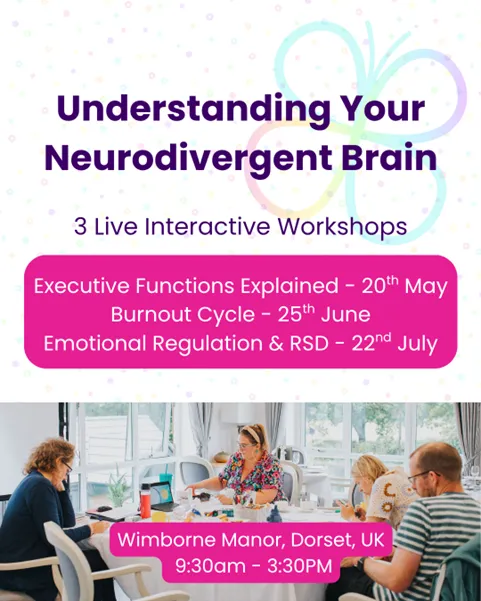
Each event is a full day to explore how your brain works, why things feel hard, and how to start working with your brain instead of against it.
📍 Wimborne Manor, Dorset
🕐 9.30am – 3.30pm
☕ Includes refreshments, snacks, lunch, workbook and a little gift